A FileMaker alternative that starts with your export.
FileMaker is priced per user. Export the records, drop them below, and get the same records back as a database your whole team can open — in the browser on any OS, or the desktop app on macOS, Windows and Linux — with flat pricing, unlimited people and no per-user licence. What a FileMaker export takes with it and what it quietly leaves behind is set out further down, from Claris’s own documentation.
Before you move anything, it is worth knowing exactly what a FileMaker export takes with it and what it quietly leaves behind: we collected what Claris documents about its own export, quoted and linked.
Where this is up to
- Works today, on any OS, in your browser — nothing to install, and there are macOS, Windows and Linux desktop apps as well.
- Windows is a download now; there is no iPhone or Android app yet. The Windows app is not code-signed yet, so the first time you run it Windows shows a blue “Windows protected your PC” box — click More info, then Run anyway. Some antivirus flags it for the same reason. A certificate is bought, not written, and we would rather ship the app and say this plainly than keep you waiting on a purchase order. The phone apps get built the moment someone needs them.
- Offline is a desktop feature. The encrypted local database ships with the desktop app — macOS, Linux and Windows. In the browser it is not true: that needs a connection, and I'd rather say so here than have you find out on a train.
- The local database file is encrypted on disk (adiantum full-file encryption), and the key lives in your operating system's own secure store rather than in the file.
- Calculation fields do not calculate yet. This is the one that matters most if you are coming from FileMaker, because FileMaker files are full of them. Collections, fields, links between records, screens and permissions all work. A calculated field can be created and labelled, but nothing works out the value, so it shows as empty with a note saying why. If the worth of your app is mostly in its calculations, that is worth knowing before you move anything rather than after.
- I'm not going to tell you FileMaker or Access is dying. Neither is — FileMaker 2026 shipped and is supported, and Access is still shipping. The only thing I'm claiming is a different pricing model and a different shape of app.
What it actually looks like
Both of these are the CRM template as it ships — one click from an empty account, no setup. They are screenshots of the running product, not mockups.
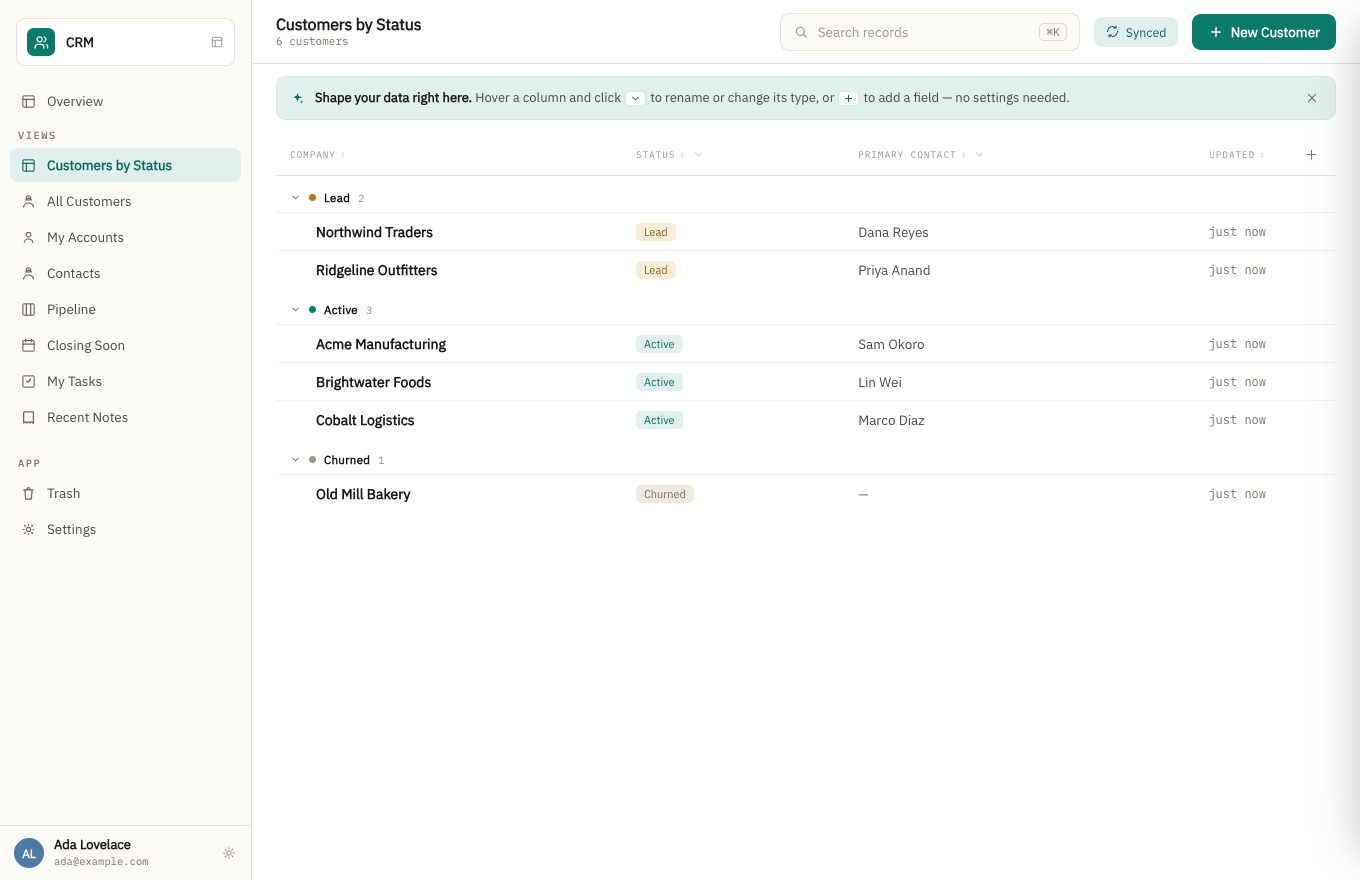
A grouped list view. Fields are changed in the app’s settings, or by asking the assistant, never by accident from the list.
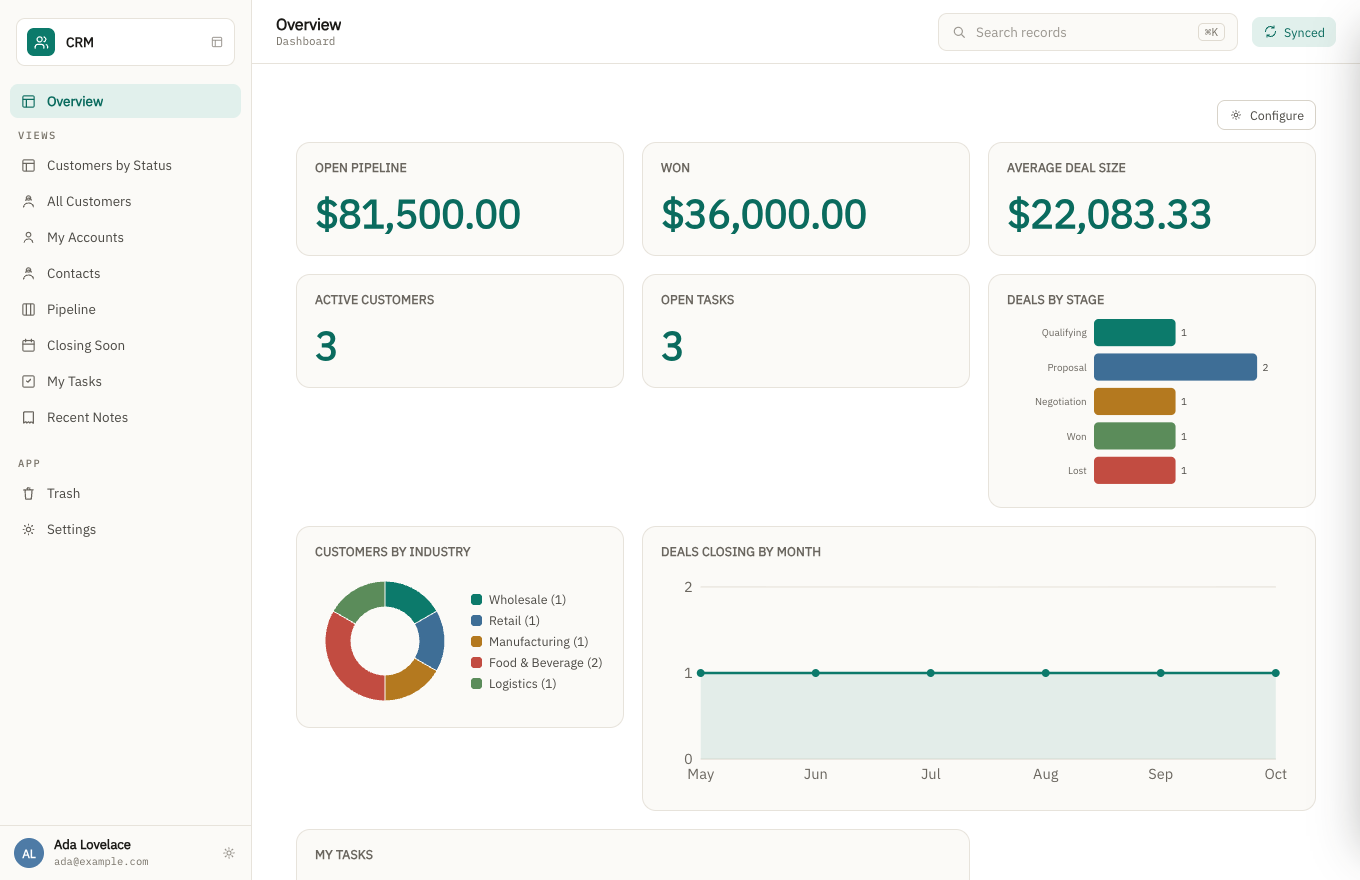
The same app's dashboard. The charts read live from the records above, not a separate reporting tool.
Yes, there are portals
FileMaker calls it a portal: records from a related table, shown on this record. Here it is called a related list and it is the same idea — a customer's jobs sit on the customer, and the line items sit on the job.
You can check that claim yourself in about thirty seconds, with no account and no email. Open the demo — it is a working Northwind database — and open any Employee. You will see the orders that employee took and the people who report to them, which is a table related to itself. Open an Order for its line items, a Product for the orders it appears on, or a Supplier for what they supply.
Two honest limits on that. A record can be reached from more than one parent — an order hangs under its customer and under the employee who took it — which is the part a single-parent hierarchy cannot express, and it is why an imported database otherwise arrives as unrelated tables. But the related list does not total itself: as above, calculation fields do not calculate yet, so a portal showing five line items will not show you their sum.
Found sets, browser access, container fields
Found sets. Every list has a filter, sort and group toolbar. It narrows on the server rather than hiding rows in the browser, it is yours rather than a change to the app everyone else sees, and it rides the address bar — so sending a colleague the exact set you are looking at is sending them a link. In the demo, filtering Products by Category to a name containing "Queso" takes it from eight groups to one.
Browser access. There is no separate web product to buy or stand up. The same app runs in a browser, and because the price is flat rather than per user, putting the warehouse, the contractor and the client in it does not change the bill. The desktop app is the same app again, and it keeps working with the office network down.
Container fields. Files attach to records, are encrypted in the local database, and sync like anything else. One caveat in the spirit of the rest of this page: the demo has no attachment fields in it, so that is the one thing here you cannot go and check in thirty seconds. Take it as a claim, not as something demonstrated.
How the pricing works
Flat, by what you build — never by how many people use it. Add the whole team, the contractor, the client who needs read access: the price doesn't move.
What that's worth comparing against, in Claris's own published numbers rather than mine: their cloud plans read $22 per user per month, billed annually, 5–10 users only for three apps, and $45 per user per month for 5–99 users. Both start at five users, so the smallest bill you can write is five seats — about $1,320 a year — for three apps and a ten-person ceiling. Ours is $29 a month, and however many apps and people you like.
What happens when the person who built it leaves?
That's the question this is really built around, and it's the one I'd genuinely like to hear your answer to. A departmental app usually outlives the person who wrote it, and what's left behind is often a file nobody can safely change.
- The app is described, not codedDoc types, fields, views and workflows are structured definitions — the next person reads what it does instead of reverse-engineering a script.
- Every change is a revisionRecords keep their history, so "who changed this, and when" has an answer after the original author is gone.
- The data is a database on your machineOffline-first and encrypted, syncing when it can. If my company disappeared tomorrow, the file wouldn't.
- Roles are part of the appPermissions live in the app definition, so handing it over doesn't mean rebuilding who can see what.
The three things that actually make leaving FileMaker hard
Every “FileMaker alternative” page tells you to export to CSV and get on with it. Having done this with a real solution, the export is the easy part. Three specific things are where people lose days, and none of them is obvious until you are in it.
1. The export takes what is on your screen, not what is in your table. Claris’s own documentation is explicit that the export dialog defaults to the current layout and offers only the fields visible on it. A field parked on a tab panel you were not looking at is silently absent from an export that reported success. Nothing warns you. The fix is to switch the dialog to the table rather than the layout, per field-set, every time — the full walkthrough with the Claris citations is here.
2. Relationships come out flattened, one related table at a time. A FileMaker solution’s value is usually in its relationship graph — invoices to clients, jobs to sites, notes to everything. CSV has no way to carry that, so each export is one table with the related values inlined as text. If you exported the client’s name rather than the client’s ID, the link is not recoverable by any importer, ours included: two clients called “J. Smith Ltd” are now indistinguishable. Export the key columns, even the ugly ones.
3. Scripts and calculations do not export at all. There is no file format that carries them out. If the business logic lives in FileMaker scripts, moving is a rewrite of that logic, and it should be priced and planned as one rather than discovered in week three. Copy them out as text before you give up your licence, because after renewal lapses you cannot open the solution to read them.
That last point is the one with a clock on it. FileMaker is a subscription: when it lapses, the application stops opening, and your .fmp12 becomes a file you own and cannot read. Whatever you decide about us, get your data and your script text out while the licence is live.
What we do with a FileMaker export that generic importers do not
Our loader rebuilds real relationships from the key columns you exported, rather than leaving you with text that looks like a link. For every row it reports which of four things happened — resolved, empty, missing, or ambiguous — kept apart rather than lumped into a single success count, and it keeps your original column so the step is reversible.
It refuses rather than guesses. An unmapped column, two columns colliding onto one field, a date that could be March or April, or a dropdown value outside the field’s own options all stop the load and ask. This is not caution for its own sake: a wrong link asserts something untrue in a place nobody will ever check it.
It has been run in anger rather than only in tests — it carried a real 11,069-file, 62,691-note account export into a working app with the links intact.
What you can do yourself, today
You don't have to wait for anyone to move your data. FileMaker exports CSV, and the app reads one directly: drop it in and it builds a collection in one step — a field per column, each typed from what the column actually holds (dates as dates, amounts as numbers, a column of a few repeated values as a dropdown), named from your data, with a meter while the rows go in. Anything it typed wrong you change afterwards in the app's settings.
Where it can't tell, it asks rather than guesses. A column of dates like 03/04/2026 could be
the 3rd of April or March 4th, and the rows it would get wrong look exactly like the rows it would get
right — so it stops and asks you which, and won't import until you answer. If one value anywhere in the
file can't be read, nothing is imported at all: a half-loaded collection is worse than an empty one,
because you can't tell which records made it and running it again duplicates the ones that did.
Import your tables into the same app, one file after another and in any order, and it looks for the links between them — an order that names a customer ID gets connected to its customer, so you can open one and see the other. It only links where both the column name and every value agree; where it isn't sure, it leaves the values alone rather than guessing.
Where it stops: it moves data. It does not convert layouts, scripts or calculations. Those are a rebuild, done in the app itself — this just means your records can be in front of you in a couple of minutes rather than waiting on that.
And an export is only half of getting your data in. The other half is the people who do not work for you. Any collection can be opened as a public form at its own link — plain HTML that works on any phone with no JavaScript, so it survives an old browser or a QR code taped to a wall, and it closes on a date or after a set number of entries. So the part of a FileMaker system that usually needs WebDirect, a licence per person or a layout nobody maintains is just a link you send. Entries arrive as ordinary records with full history, marked as coming from the form.
You choose which fields the page asks for, and the ones you keep for yourself — turned up, paid, your own notes — are not on it. That much is cosmetic, and a field name is guessable. What is actually true is that the server refuses a field the door did not ask for, so a stranger who guesses the name still cannot set it.
What this is not
It isn't a FileMaker or Access importer — there's no automatic conversion of an existing solution, and I'm not going to pretend a rebuild is a click. It isn't a spreadsheet, it isn't a form builder, and it isn't finished software with a track record. It's an honest early product with a pricing model that doesn't punish you for adding people, and I'm looking for a handful of people willing to tell me where it falls short.
And the question you should be asking a company this small: what happens to your data if we go out of business? The answer, with the mechanism and its limit — two export buttons and a file on your own machine, not a reassuring sentence.
What it costs to find out
Nothing, and there is no call to book. Open the demo, click around a real database, and decide for yourself. If you want your own, the free tier is genuinely free and takes a minute.
When you are ready to bring your own data, the app reads a CSV directly and works out how your tables relate to each other — that is the part described above, and it is self-serve. You do not need me for it.
Or do not build it yourself. Describe the app your business runs on and we will build a working version of it and show you — no fee, no card, and the app we build fits the free plan. How that works.
Still shopping around? I wrote up every FileMaker alternative I could find, with verified prices, the pricing traps named, and the cases where one of the others is the better answer than mine. It is the page I would have wanted when I was the one comparing.
Bionic Forms is built by Matt Bidwell (Bionics LLC). If something here reads as overclaiming, tell me and I'll fix the page — that's a promise I can actually keep at this stage. Either way you can reach me at matt@bidwellhq.com.